
 Live Radio
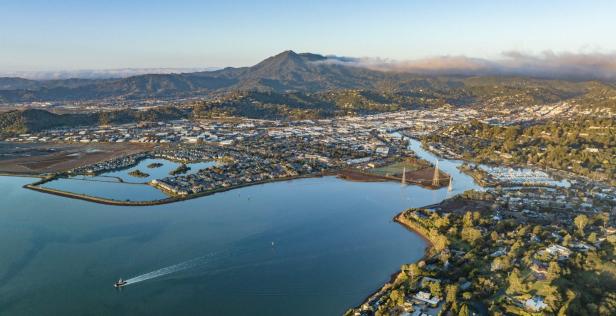 photo credit: City of San Rafael
An aerial photo shows San Rafael's Canal neighborhood (center) at the
outlet of San Rafael Creek.
San Rafael is seeking a federal tax incentive known as an Opportunity Zone, this time deliberately, knowing it could become a double-edged sword.
Housing and business projects in economically distressed communities, like the Canal district of San Rafael, are considered riskier investments. An Opportunity Zone makes it easier for businesses and developers to find investors through a Qualified Opportunity Fund, an investment vehicle that pools money from investors to fund businesses and real estate in low-income communities.
Investors can avoid or temporarily defer federal tax on eligible capital gains earned through the fund. Because investors get a tax break, they may be more willing to put money into projects that might otherwise seem risky.
The Opportunity Zone program was created in 2017 through the federal Tax Cuts and Jobs Act and made permanent in 2026 in President Donald Trump's administration's budget bill, H.R. 1.
California has a current total of 2,469 eligible Census tracts, and the governor may nominate a quarter of them, up to 618, for certification by the U.S. Department of the Treasury by September 30.
In the first season of the 10-year program, most investments have gone into mixed-use housing developments.
According to San Francisco-based financial services firm Novogradac, which has been tracking investments since the start of the incentive, about $34 billion has gone to develop multifamily properties with a commercial element on the lower floors. That is far more than the $9.2 billion going into housing-only projects.
"There are certain projects that I think could show up in our communities, things that we don't want," said San Rafael City Councilmember Eli Hill at a June 16 meeting of the city's Economic Development and Housing Subcommittee. "Certain types of investments that could end up, without the right guardrails, could be opportunities for displacement and extractive activities."
Three out of the five Census tracts in San Rafeal deemed eligible for Opportunity Zone designation are in the Canal district. The area, just under 2.2 square miles, is where a vulnerable Hispanic community of over 13,000 low-income residents live in crowded multifamily homes.
The Canal is a man-made peninsula, where the land has settled over decades, and much of it sits below the level of daily tides. In early January, king tides and storm surge peaked above 8 feet and topped the edge of the Canal, flooding the neighborhood with Bay water, submerging vehicles and leaving many of its rental residents islanded.
The city is considering ways to adapt the Canal for sea level rise, ranging in price from $719 million to $2 billion. The options include building barrier walls, installing a flood gate in the San Rafael Canal, or raising the land at the water's edge and developing it with new buildings and parks.
That third alternative would require acquisition and redevelopment of dozens of waterfront properties, displacing occupants of 86 shoreline buildings and potentially forcing permanent relocation of some residents.
An influx of property investment might save the Canal physically but trigger displacement. A similar situation occurred during the first Opportunity Zone designation.
In 2018, the Census tract closest to the canal waterway was designated a zone, according to Omar Carrera, CEO of the Canal Alliance, a nonprofit that serves the Latino community and other residents of the Canal.
Carrera said the state did not consult with the city or local stakeholders about it. He said the tract was a bad fit for the program, because it had no undeveloped land and housed the district's most vulnerable residents. Speculative real estate investors began to purchase buildings. They raised rents and evicted residents to make renovations. The city responded with an ordinance to establish relocation fees for residents in properties specifically in the Opportunity Zone.
This time around, the state is encouraging local governments to participate in the selection process.
A committee of the San Rafael Chamber of Commerce called the East San Rafael Working Group includes the Canal Alliance, east-side businesses and other stakeholders. In May, the working group recommended that the city prioritize one Census tract in the Canal, tract 1122.02, as an Opportunity Zone.
"We're looking for opportunities where we can create conditions for the private sector, for the public sector, and for the community to benefit," said Carrera. "But that will require that we bring landowners, business owners, the government, the community all together to have that conversation."
Carrera said the working group is modeling the Chicagoland Opportunity Zones Consortium, which focuses on coordination and matchmaking, helping connect investors and developers with projects that have already been vetted and supported by local stakeholders.
"So, if you're an investor, you will prefer to go to a place where all those stakeholders are aligned with shared priorities, because the capital risk is reduced if you're not going to be facing a lot of opposition or pushbacks," Carrera said.
Also in May, the Canal Alliance released a Canal vision plan based on community engagement. The Canal Neighborhood Snapshot includes a list of Canal resident wishes, including a vendor market, a pedestrian bridge and a mixed-use affordable housing site with childcare, grocery and recreation space.
Census tract 1122.02 also includes an 85-acre salt marsh that sits 3 feet below sea level, called the Canalways. It is an open field between a Target shopping center, which sits 21 feet above sea level, and the Spinnaker Point subdivision, which is 12 feet above sea level. According to the city's 2040 General Plan, it is one of the largest privately-owned properties in San Rafael.
A portion of the Canalways is currently designated for light industrial/office uses, with the rest set aside for conservation. The plan said an extension of Kerner Boulevard may be required when the site is developed.
"A General Plan Amendment could be considered in the future to allow additional uses, potentially including housing in the northwest part of the site," the plan said. "Revenue generated by new development can help offset the cost of infrastructure improvements needed to make Southeast San Rafael more resilient."
The East San Rafael Working Group said it is not making any specific property recommendations at this time, according to Canal Alliance spokesperson Isabel French.
"Some owners of Canalways have historically participated in the ESWG but have not been specifically singled out for any engagement on the Opportunity Zone," she said.
The governor's window for local jurisdictions to nominate preferred tracts closes July 25. Final decisions go into effect January 1, 2027. The designation lasts for 10 years, when the whole process begins again.

 NPR
NPR Spotify