
 Live Radio
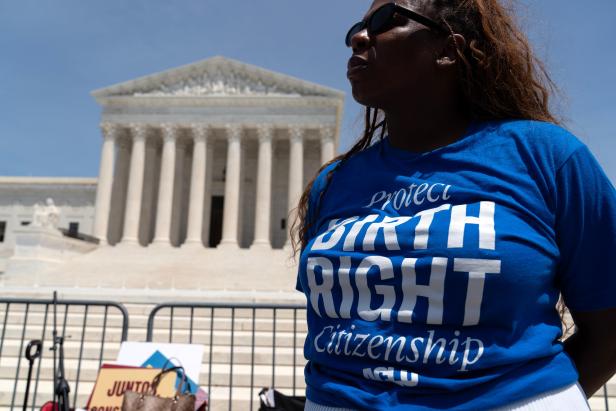 photo credit: AP Photo/Jose Luis Magana
Activists celebrate the Supreme Court's birthright citizenship ruling outside of the Supreme Court on Capitol Hill, Tuesday, June 30, 2026, in Washington.
This week, the Supreme Court struck down an effort to end birthright citizenship, drawing criticism from President Donald Trump and relief from many immigrant families. KRCB’s Shandra Back speaks with VIDAS supervising attorney Nicole Gorney about the immigration court cases they are handling.
KRCB: How would you describe this moment for immigrants in Sonoma County right now based on what you're seeing at VIDAS?
GORNEY: There is still a lot of fear in the community, and we are still just working on every day to replace that fear with power and community support and organization.
But there are a lot of targeted arrests, meaning that ICE is looking for one specific individual, but still just the presence of ICE in the community at all affects everyone, documented or undocumented. And so any time you see masked ICE agents in these unmarked cars driving around any neighborhood, it just spreads so fast.
KRCB: And have there been targeted arrests in Sonoma County in previous years?
GORNEY: There's always been targeted enforcement, throughout any administration, so certainly of anyone with a prior removal order, yes.
KRCB: What are the main types of cases that VIDAS and your attorneys are looking at right now?
GORNEY: We have a lot of detained cases of people who had entered the United States many, many, many years ago. We're talking over 20 years ago, 25. And the government thinks that they can classify that person now as an arriving alien, and that because of that they have the right to arrest and detain them.
And they are not winning that argument in the district courts. All the district court judges are saying somebody who's been here for many, many years and is arrested in the interior and not at the border is not classified as an arriving alien and that because of that, they have the right to arrest and detain them.
And they are not winning that argument in the district courts. All the district court judges are saying somebody who’s been here for many, many years and is arrested at the interior and not at the border is not classified as an arriving alien. But they are just doubling down on that in many of their arrests right now.
KRCB: You'd say that's kind of your top battle that you're facing?
GORNEY: The top battle that we're facing is getting matched with those folks quickly enough because a lot of times when people are detained and they can't consult with an attorney and they have no idea what's going on, they're faced with being detained indefinitely. They might just decide quickly to be removed to their home country.
KRCB: So help me understand then. This is maybe a person that's been in the United States 20 plus years and they are then detained. Where are they being detained?
GORNEY: What we are seeing a lot of is what we call these collateral arrests. So we were looking for person A, didn't find them, but hey, we also found person B at this house who is also undocumented and we bring them in instead.
KRCB: Then without a lawyer, what would happen to these immigrants?
GORNEY: They're pressured very quickly by ICE officers to accept a removal order or accept a quick departure because if not, they think I could be here for months if not years. And if they don't know their rights or if they don't know what their options are for relief, that is very tempting to take that removal order rather than just sit there for months.
KRCB: Can you tell me about a recent client whose story captures what this moment feels like for you?
GORNEY: We had a client who had lived in the United States for 26 years. He had three US citizen kids. He owned property here. Him and his daughter had a business together.
And he was arrested because they were looking for someone else, and he was just there, wrong place, wrong time, at his home. And he was brought to San Francisco for processing, and then we filed a habeas while he was still in San Francisco. And then he did get transferred to the Mesa Verde Detention Center.
We got an order from the district court that he must have a bond hearing, and so he was released on bond. And it was great when he was released, but at the same time, I'm so frustrated because him and his family had to pay $10,000 to be released when I don't think he should have ever been arrested and detained in the first place.
So at the same time, that was a win, and we had to celebrate it, and it was great that he's back with his family now. But we have to redefine what wins look like sometimes, and I think that's hard for me.
KRCB: So how are you redefining what a win looks or feels like now?
GORNEY: That a win might not necessarily be somebody being granted relief by an immigration judge, but a win might be the fact that they had an attorney next to them at the table, and they had proper due process. They didn't just have a half-an-hour hearing.
And whatever the result of that case is, we can appeal and keep that case alive. And so even though it's not a win on paper with what happened that day with the judge's decision, the fact that they got representation and had a full hearing, we need to count as a win.

 NPR
NPR Spotify