 Live Radio
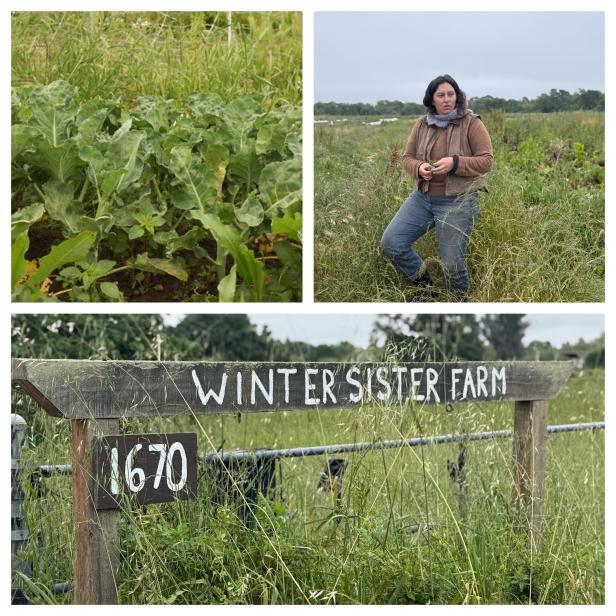 photo credit: Noah Abrams/KRCB - Juliana Yamada/KQED
Winter Sister Farm's Anna Dozor (top right) surveys the remaining vegetable beds and
winter greens like broccoli rabe (top left) ready to be harvested on 7 May, 2026.
In April, the House of Representatives passed their 2026 Farm Bill. Now the US Senate is working on their iteration of the massive legislation package, the first since 2018.
But while Congress debates, many small farmers are still reeling from the second Trump administration's blitz of the federal bureaucracy in early 2025.
The loss of one program in particular has been hard felt across Sonoma County, and by those who farm and work in the local agricultural economy, like Dylan Stein.
Stein is no stranger to the challenges of small farming.
"There's this like feeling in the kind of farms that we work with that they're always like sledding uphill a little bit," Stein said, standing in a side room at FEED Co-operative's warehouse in Petaluma.
Stein is the wholesale manager at FEED, Farmer's Exchange of Earthly Delights.
The co-operative was founded in 2011, and he's been involved in local agriculture in Sonoma County for nearly a decade.
At it's buzzy warehouse, FEED sources fresh produce and farm goods from a network of over 30 farms, mostly in the North Bay Area.
They sell wholesale to restaurants and institutions like food banks, and directly to retail customers through popular community supported agriculture boxes.
The co-op was one of 35 food hubs across California who were part of a program called LFPA.
"We're like for the first time it's like oh this actually like feels like there's tailwinds for us," Stein said of the program.
To understand what Stein is talking about we have to back up to 2021. That's when the Biden Administration's Department of Agriculture first piloted LFPA - the Local Food Purchase Assistance program.
Lisa Held, a reporter and editor at Civil Eats, a food and agriculture focused news site, said the idea for LFPA, and it's sister program, Local Food for Schools, was to help primarily small and disadvantaged farmers access stable wholesale markets.
"Specifically it was funding connections between these farms and food banks," Held said.
A major advocate for LFPA has been the Community Alliance with Family Farmers, CAFF. Jamie Fanous is their policy and organizing director.
"Around 850 farms have been involved in LFPA," Fanous said. "That also includes over 50 different aggregators, small-scale aggregators, and community-based aggregators, and over 50 food banks or community based organizations distributing food across the state of California."
The food purchased through the program, called Farms Together in California, had to come from in-state or within 400 miles from the destination.
It allowed say a food bank in Crescent City on the coast near the Oregon border, to buy cabbage grown locally as well as oranges grown near Sacramento.
"It really was designed different differently, in that it was meant to uplift local economies and small-scale farmers," Fanous said. "So, every dollar spent on a small farm essentially brings back $2 into the economy. So, it was this opportunity to really feed and address like some real serious food access issues in our communities, while also investing in our local agricultural economy."
LFPA brought in over 80 million in federal dollars for California farmers, but in March last year, that whole ecosystem was shattered when current USDA Secretary Brooke Rollins abruptly cancelled the remaining funding.
It was a big and unexpected hit for farmers like Anna Dozor.
"The beauty of the LFPA was in its like simplicity and...the lack of complexity in that it wasn't a separate thing," Dozor said. "It was just buying the produce that we are already growing."
Dozor runs Winter Sister Farm in Sebastopol, along with her sister and a small farm crew. She said wholesale, the kind of purchasing LFPA funded, accounts for about 30% of their business.
"We didn't have to...jump through hoops to get it and...the food was just going to people who needed it," Dozor said. "And we're providing healthier food options to people who often are just like stuck with the lowest common denominator of availability."
Civil Eats' Lisa Held said the guaranteed market meant farmers had the chance to grow.
"A lot of the farmers I spoke to in New York were be able to really start putting up new infrastructure, maybe building an extra high tunnel," Held said. "The farm that I went to in Pennsylvania, [the farmer] said instead of one bed of lettuce, he was planting three."
Minnesota has continued its own version of LFPA, and in California, the state legislature just added $15 million in the state budget to continue Farms Together for another year to help ease the sudden loss of federal funding. It's only a fraction of the $45 million the state was meant to get for LFPA purchases, but advocates said they hope the money can act as bridge for farmers to solidify wholesale relationships.
At the federal level, the chance for a revival of sorts remains.
Included in the current farm bill is a program called the Local Farmers Feeding Our Communities Act. It's almost the same as LFPA, but Jamie Fanous with CAFF said it's got a major issue.
"So the original LFPA program received nearly a billion dollars in investment...A $200 million appropriation is not the same," Fanous said. "The language authorizes $200 million every year. It does not say this is a mandatory spending allocation for this program."
For farmers like Anna at Winter Sister, bringing back some version of the LFPA program is a no brainer.
"Everyone was happy with it on all ends," Dozor said. "You know, the farmers were happy with it, the cooperatives were happy with it, the food banks were happy with it, the politicians were happy with it."
But she said it's hard for small farmers to find time for the political wrestling DC and Sacramento.
"When I have a chance to like speak out and say what's helpful and what's useful to us as farmers, I do that, and then when the funding is there, I'll take it," Dozor said.
For Dylan Stein at FEED Cooperative, the story is the same. He said he'll miss the boost LFPA and it's guaranteed funding gave them, but he'll continue to advocate and participate in the Farms Together program, at least to the extent $15 million dollars goes, and he said FEED will still do it's part to find and foster markets for it's many members.
Sonoma County is likely to receive about $300,000 for the one year Farms Together funding proposed in the current state budget.
The 2026 federal farm bill passed the house of representatives and is currently being worked on by the US Senate.

 NPR
NPR Spotify