 Live Radio
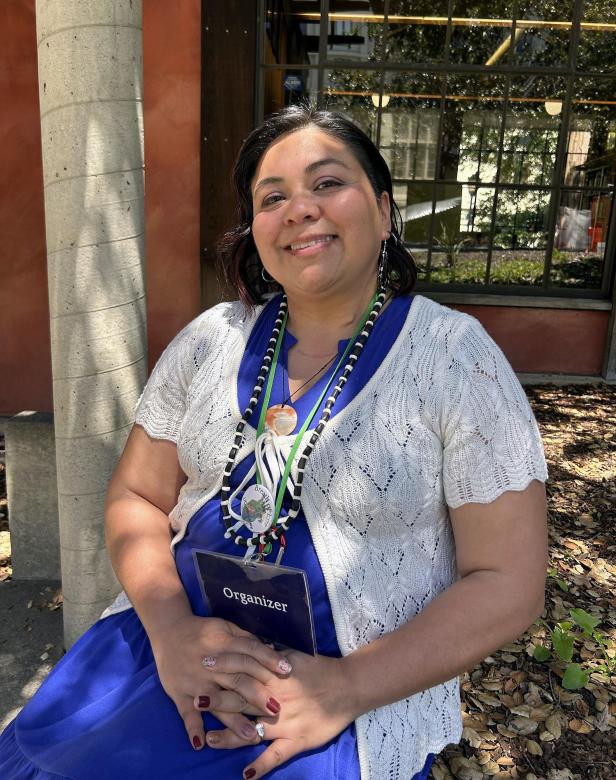 photo credit: Allison Herrera
Executive Director of Advocates for Indigenous California Language Survival Carly Tex.
Inside the California Language Archive on the UC Berkeley campus sit boxes, recordings, field notes, grammar documents.
They are the painstaking work of linguists and anthropologists who traveled to California's Indigenous communities throughout the 20th century, listened, transcribed, and then brought the material here -- to a library, far from the Indigenous communities they worked with to gather the material.
For decades, many of those boxes sat untouched by the communities whose voices filled them.
But for one week each summer, that changes. Breath of Life, the language reclamation workshop organized by the Advocates for Indigenous California Language Survival, brings California tribal members to Berkeley to do something quietly radical: take their languages back.
"We like to use the word sleeping," said Carly Tex, a Western Mono tribal citizen and the director of the Advocates for Indigenous California Language Survival, who has led the organization since 2019. "Because it's just waiting for someone to reawaken it."
The Breath of Life conference began in 1995, after a gathering of Native activists and artists in Northern California asked, "What do you do for communities that have no living speakers left to learn from?"
UC Berkeley, which holds the largest archive of California Indigenous language materials in the world, became the answer -- and the home.
During each session, participants from Indigenous communities across California called "community researchers" are paired with professional linguists who help them navigate materials that were written, in many cases, for academic audiences -- International Phonetic Alphabet or IPA charts, morphological analyses, field notebooks dense with specialized notation. The goal isn't just translation but reconnection.
"They're reconnecting with their ancestors," Tex said. "For some of them, they're opening up materials that their great-grandparents actually contributed to."
Tex remembered the first time she heard a recording of her own language at the archives.
"I felt this weird sensation in my stomach. It was almost, it was like sickening, like, oh, that's them, oh, that's them, and I felt like I was the first person to hear them," she said. She said she had a vision in her mind of her ancestors singing, maybe playing hand games.
"It was like taking a little step into the past."
What survives differs from tribe to tribe
Not every community arrives at the archive with equal footing. For some tribes, the shelves hold boxes upon boxes of recorded speech, grammar notes, and cultural documentation. For others, what survives is a fragment.
"For every five boxes you guys have, we'll have half of a box," said Sandra Hernandez, a member from the Kitanemuk community, whose language had only about four individuals who could still speak it when documentation work was done. "For every three picture albums, we'll have two pictures. And sometimes that could be a very emotional thing."
Hernandez' community came to an unexpected discovery during this year's conference. Sifting through materials collected by linguist Dr. Alice Anderton -- who also created the Kitanamuk-to-English dictionary -- the group found a story they had never seen before. It had been remembered and shared by tribal elders Dolores Montes and Celestina Montes, members of one of the community's family lineages.
The story was retold during one of the final presentations to other workshop participants. It featured a tarantula perched in a pine tree, singing. The more he sings, the heavier the snow falls. Coyote emerges, surveys the depth -- ankle-deep, he announces -- and sends the mouse a up the tree to check. Mouse reaches the top, meets Tarantula, falls off, knocks himself out, and doesn't wake until summer.
It's a story that carries teaching in it, the way traditional stories do -- about animals, about behavior, about consequence. And now it belongs to the Kittanemuk community again.
Jake Hernandez, who presented the story, laughed a little, describing how he'd been up until three or four in the morning re-listening to the recording, trying to get the details right. He spoke the words of the story in the Kitanemuk language, and his mother translated them into English, line by line.
The room listened and laughed.
Rejecting the concept of language "extinction"
Wesley Leonard, a linguist and citizen of the Miami Tribe of Oklahoma, has attended Breath of Life for more than twenty-five years -- first as a community member grappling with his own language, now as a language partner and professor of ethnic studies at UC Riverside. He gave a presentation during the week on what he calls linguistic sovereignty: the right of a language community to set its own goals, define its own relationship to its language, and reject outside assessments of what that language is or isn't.
"Languages are not things that disappear," Leonard said in an interview after his talk. "It's true that sometimes communities have stopped speaking or signing their languages, but they can start doing that again. And that doesn't work with the whole extinction metaphor."
He prefers the word reclamation to revitalization -- a distinction that may sound subtle but carries weight. Revitalization, he argued, tends to treat language as an object to be repaired. Reclamation puts the focus where it belongs: on the relationship between people and their language, ruptured by colonialism, and now being rebuilt.
"The language is fine," he said. "All of the knowledge that's encoded in my tribal language and other languages -- that's fine. The problem is the relationship."
Not far from the archive building, a group of Tongva/Gabrielino and Kumeyaay speakers gathered to share a song they had composed together during the week. It was a fire song -- a song about the fire spirit, about prayers rising in smoke, about community and rejuvenation.
Virginia Carmelo, a Gabrielino Tongva from the Los Angeles Basin, has attended Breath of Life and began studying the language twenty-two years ago. At that time, there hadn't been a fluent speaker since the 1930s and '40s.
"When I first started, I wondered: who could I speak to if I ever learned how to speak?" she said. "There were no other speakers. There was only one other learner."
Then her grandchildren were born. She started speaking small words to them -- commands, names, greetings. Post-it notes went up around the house. Her granddaughters, Neshuun and Paahavet Carmelo, who are twins, attended Breath of Life this year for the first time.
Breath of Life does not solve the language loss California Indian communities experienced after missionization, the gold rush and a state sponsored campaign of genocide led by Gov. Peter Burnett.
The materials in the archive were gathered under conditions that were often extractive, organized in ways that reflect academic priorities rather than community ones, and they remain physically distant from the people they document. The work of reading them, interpreting them, and carrying them home is slow.
But Breath of Life offers something that keeps people coming back.
"Once you get started with this kind of language work," Carmelo said, "it's really hard to put it down and walk away."
She smiled. "It is people work. And that's the whole point."
 NPR
NPR Spotify