
 Live Radio
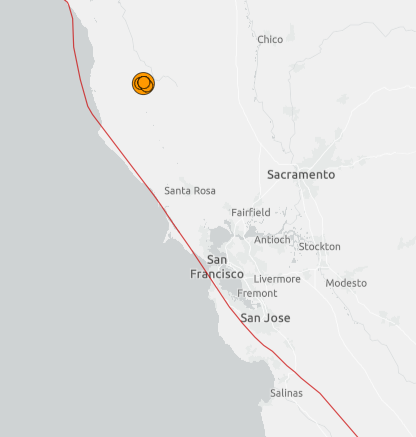 photo credit: USGS
Screenshot on June 24, 2026 of the map on the USGS
website showing recent earthquakes.
Many Bay Area residents were alerted by their phones Wednesday morning when a large earthquake struck in far-off Mendocino County, despite the fact that most people in the region didn't feel the slightest wobble.
When the magnitude 5.6 earthquake struck at 8:10 a.m., the ShakeAlert Earthquake Early Warning System sent notifications to well over 1 million people throughout Northern California, said Robert de Groot, a scientist with the U.S. Geological Survey Earthquake Science Center in Pasadena.
As soon as the quake hit, the ShakeAlert system published early warning information to USGS servers, and "the operators," including the iOS and Android operating systems, the Federal Emergency Management Agency's wireless alert system and the MyShake app, among others, received that data within seconds, de Groot said.
As soon as the quake hit, the ShakeAlert system published early warning information to USGS servers, and "the operators," including the iOS and Android operating systems, the Federal Emergency Management Agency's wireless alert system and the MyShake app, among others, received that data within seconds, de Groot said.
"It then goes out to peoples' cellphones," he said. "It's streamlined to move information, translating to what people should do within seconds of when that earthquake is starting."
The system isn't an earthquake prediction service, rather it uses ground and satellite sensors to detect fault movement in real time.
The fastest-moving seismic waves are called primary or P-waves and they travel at about 3.7 miles per second in rock and usually don't cause strong shaking. The P-waves are followed by slower moving, more damaging waves called secondary or S-waves.
The ShakeAlert system reacts to the faster moving P-waves and thus is able to give people a few precious moments' head start prior to the secondary waves' arrival.
"If you're super close to the epicenter of the earthquake, you're probably going to feel the earthquake before the alert," de Groot said. "It's blazing fast but limited by the laws of physics, unfortunately."
Early data indicates that at least 657,000 people got an alert from MyShake Wednesday, a number that's likely to end up being "well over a million" when the final tally comes in, he said.
Also, the reason people as far away as Oakland, Berkeley and Concord received the alerts is because the system's minimum delivery threshold is set at a "weak" Modified Mercalli Intensity value.
The MMI value is different from a magnitude measurement in that it represents the possible effects from a quake, like swinging lights or swaying buildings, rather than seismograph readings.
During a weak MMI quake, only a few people in taller buildings might feel any shaking, or it might feel like a truck is rumbling past someone's home, for example.
By alerting at lower MMI levels, MyShake gives people closer to the epicenter more time to react, de Groot said, but it also increases the distance at which people might get an alert even if they never feel the rumbling.
Also, there is variation in the system because different cellphone operating systems push out alerts at different thresholds, he said.
While some people might be confused after getting an alert for a quake that they can't feel or that's far away, de Groot said it's always good practice for when there is a major seismic event.
"We want people to react to the drop, cover and hold on," he said. "We know that seconds matter."
More information about the ShakeAlert system can be found at www.Usgs.gov/faq/beshakealertsafe.
 NPR
NPR Spotify