
 Live Radio
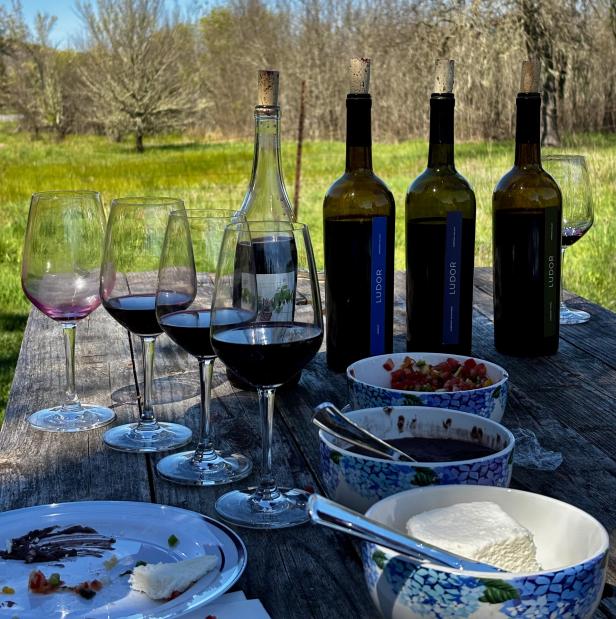 photo credit: Shandra Back/KRCB
Wine glasses and traditional Mexican flavors are arranged for a Ludor tasting at Deerfield Ranch Winery in Kenwood.
Overlooking the fields of Sonoma County vineyards in Kenwood, winemaker Salvador de La Cruz pours flavors from his new collection of Ludor Wines. Each glass is paired with a different food, yet these aren’t the typical crackers and cheese. Laid out in front of the glasses are refried beans, tortilla chips, pico de gallo and other tastes from his Mexican culture.
“Este … the Merlot, we’re doing it with refried beans,” De La Cruz tells Marinez and Mauricio Rosales, a couple who drove up from Hayward for a DIY tour of Latino-owned wineries.
De La Cruz speaks to the couple in their 30s in both English and Spanish as he leads them through the tasting — the three of them all second-generation Latinos.
The Sonoma County winemaker wears a cowboy hat adorned with red, white and green feathers, showcasing the country of Mexico, where his inspiration for the cultural tasting experience comes from.
“This is like the basics of what we already would have at our home and to see that with the wine pairing like that's so new to me,” says Marinez as she bites into a chip topped with pico de gallo. “I've not seen this anywhere else. Ever.”
For decades, Latino workers have worked in Sonoma County’s vineyards, but rarely been the ones enjoying the wines. Even as a new generation of Latino professionals gains the income and curiosity to explore wine, many still feel unwelcome or intimidated by the culture around it.
Winemakers like De La Cruz are trying to change that narrative by building a tasting experience rooted in cultural connection. And with a struggling wine market, industry experts say this could be the boost the wine industry needs.
De La Cruz explains that he grew up surrounded by wine culture. His father worked in the fields, and as a kid, De La Cruz would sometimes join him. He remembers hating the hauling and pruning.
“I remember one day I even dreamed of weeds,” he says. “I was like this is horrible I'm never going to do this again.”
His father explained that he didn’t have to. So De La Cruz took his love of Sonoma County wine country and pursued a different path — the one of a winemaker.
But the deeper he got into his studies and his craft, the more frustrated he became that the people in tasting rooms didn’t look like him or share his cultural background. He says he asked his friends to join him on tastings and they would tell him:
“I feel like I don't belong there. There's all these people staring at me. I feel out of place.”
He remembers in the beginning working in a tasting room and hearing words like butterscotch and crème brûlée.
“I was like, well I don’t even know what the heck that is, so then like I would look it up and I'm like that's like a flan,” he says.
That moment stuck with him. He realized there was a disconnect between Latinos and wine — not because Latinos didn’t like wine, but because the industry wasn’t speaking their language, literally or culturally.
So he began to try to bridge the gap with the people closest to him: his friends.
“They were kind of my experiment group,” De La Cruz says. He took them tasting, explained the basics and compared wine to beer — something familiar in Latino households. He poured lighter, fruit-forward wines first, easing them in.
Soon, he noticed a shift.
“Now they set up the wine tastings and then they invite me,” he says. “You see the confidence when they show up to a tasting room.” He says now when they order something and a winemaker is explaining terminology they’re like “‘Oh yeah, I get that or yeah, I know that.’”
For De La Cruz, that shift — from intimidation to representation — is what he says Ludor is built around. He calls his tasting a “door opener,” a way to give second-generation Latinos the tools and comfort to enter a space that has historically overlooked them.
Many of his peers are now in their highest-earning years. They’re traveling, dining out and looking for experiences their parents never had time for, he says. Yet he sees the experiment as larger than just his friends.
“Our parents sacrificed everything,” he says. “So now we can enjoy these things in life — the things they didn’t have.”
De La Cruz sees this bridge as a generational switch and a way to bring new life into a lagging wine market. And the stats back up this claim.
Christian Miller, research director at the Wine Market Council, says De La Cruz’s experiment goes much deeper than him and his growing brand. The wine industry is facing falling sales volumes, excess supply, and a generational challenge as younger consumers drink less wine.
Miller thinks winemakers like De La Cruz can bring new life.
“Hispanic Americans are important and are going to become a lot more important,” he says. Latino consumers are one of the most important, and overlooked, opportunities for the wine industry.
Latinos make up about one in five working-age adults nationwide, and one in four kids and teenagers — a future customer base that will soon enter its highest-earning years. Many already spend regularly on beer, spirits and ready-to-drink cocktails, but not on wine. Miller explains that wine is the category they know the least about.
Only about a quarter of Latino adults drink wine at all, compared to nearly a third of the general population. Miller calls it an “under-indexing” of roughly 15% — a gap that represents tens of millions of potential consumers.
Yet Miller says history shows that when the wine industry diversifies, the potential for new consumers has huge economic implications.
He points to the African American population, explaining that they are, what he calls, “the most dynamic consumer segment in the population right now.”
Back in the late 1990's, African American wine drinkers drove a major surge in sales, at one point accounting for nearly 26% of all table wine purchases, and remain an important part of the market today.
They reshaped the industry in under a decade, he says.
“That’s something that sprung up somewhat organically from within the African American community.”
Miller believes a similar shift could happen with Latino consumers — but only if the industry meets them where they are.
Back at the tasting, De La Cruz pours his Yuma Red, a wine named after his dog, as Marinez chases her own poodle who keeps escaping the leash. When she returns, they settle into conversation about the flavor palette of that particular pour.
Marinez says it’s moments like these that keep her coming back to Latino-owned wineries. “They’re very personable, they’re very approachable and they’re willing to actually sit down with you and talk about the tasting.”
Her fork pierces flan as she explains that the familiar flavors have opened an unseen world to wine.
“To see that with the wine pairing, that's so new to me, but it also makes me feel like my background and my roots are being shown at something that's not like your typical wine tasting.”
She smiles. “I already know what bottles I'm going to purchase.”

 NPR
NPR Spotify